

Scale build-up cut from a ten-year-old tank.
Long Island draws its water from a sole-source aquifer, and depending on where you are, that water carries a meaningful load of dissolved calcium and magnesium. That is hardness. It is not a health concern — it is a plumbing and appliance concern, and it costs Long Island homeowners a great deal of money quietly.
Where the damage actually happens
Hardness precipitates out of solution when water is heated. That means the scale does not build evenly through your plumbing — it concentrates in the hot side, and above all in the bottom of your water heater, where it settles into a layer that insulates the burner from the water it is meant to be heating.
A heater with a serious scale layer works harder for less hot water, costs more to run every month, and fails years earlier than it should. That rumbling or popping sound from a tank is steam bubbles forming under the scale layer. It is the sound of a heater on its way out.
The other places you will notice it
Showerheads and faucet aerators clogging with white deposit every few months.
Spotting on glassware that no amount of rinse aid fixes.
Soap and detergent that will not lather, so you use more of both.
Dishwashers and washing machines failing earlier than their rated life.
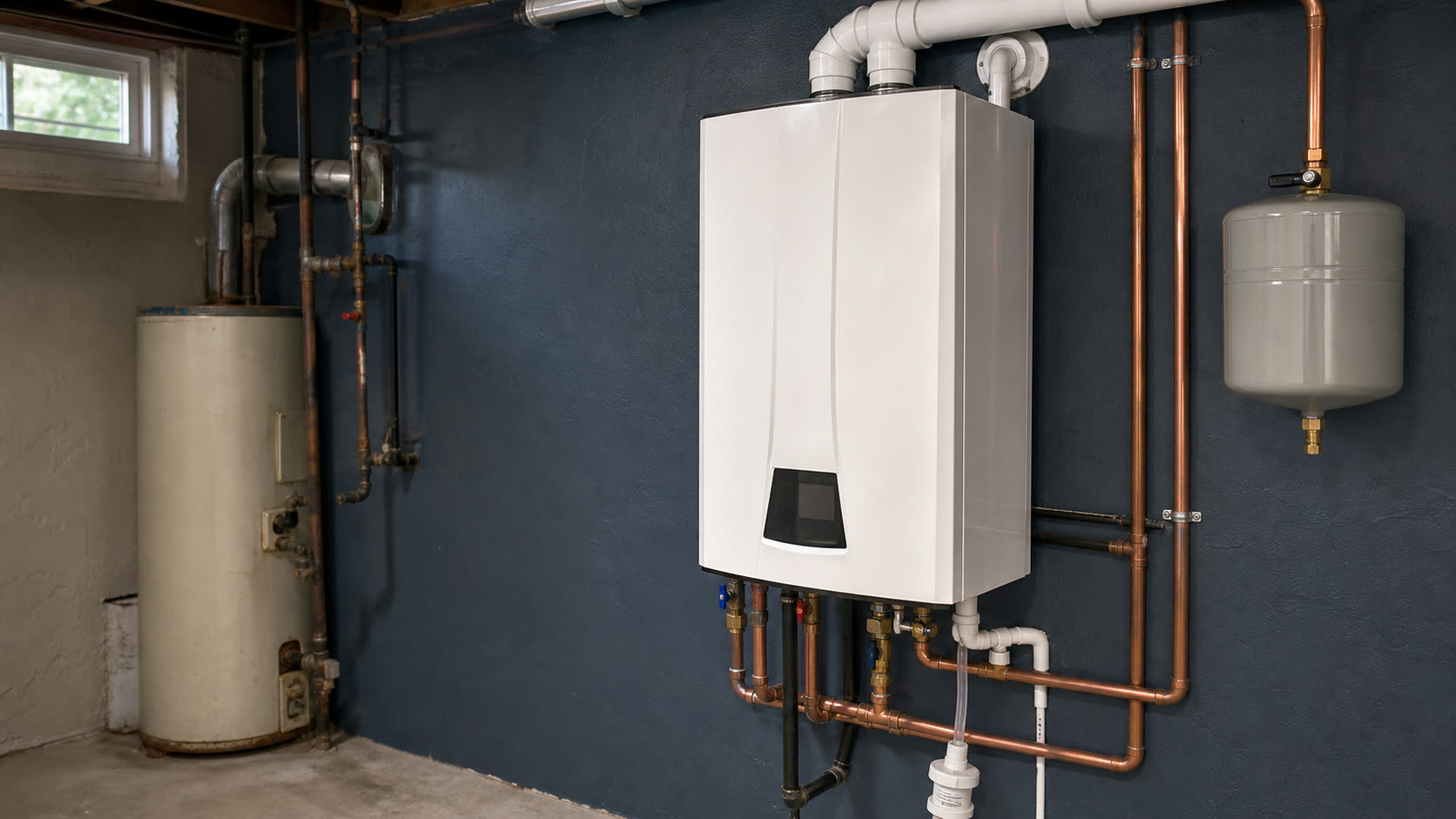
Tankless heaters losing output — they are the most scale-sensitive appliance in the house.
What actually helps
Flushing your water heater once a year is the single highest-value thing you can do, and it is straightforward: attach a hose to the drain valve, run several gallons off until it comes clear, done. On an older tank that has never been flushed, call us instead — a drain valve that has never been opened sometimes will not close again, and that is a bad afternoon to discover alone.
Descaling a tankless unit annually is not optional maintenance, it is required maintenance, and most manufacturers make warranty coverage contingent on it.
Is a softener worth it?
If your water tests above roughly 7 grains per gallon and you have a tankless unit or a lot of appliances, a softener usually pays for itself in equipment life and energy. Below that, annual flushing is generally enough. We will test your water and tell you which side of the line you are on.
Whatever you decide, put the annual flush on your calendar. It is fifteen minutes that adds years to the most expensive appliance in your basement.
Ray Flowers
Flow’s Plumbing has served Long Island since 2004. If this is happening at your house, give us a call.
Call and speak to someone who works here. Average response across Nassau and western Suffolk is about 90 minutes.
Homeowner guides
More From the Crew

Waterproofing
7 min read
Why Long Island Basements Flood — and How to Actually Stop It
High water table, sandy soil and roof water landing at the foundation. Three causes, and only one of them needs a pump.
Read article
Maintenance
6 min read
Hard Water on Long Island: What It Is Doing to Your Pipes
The white crust on your showerhead is the visible part. The expensive part is happening inside your water heater.
Read article
Water Heaters
8 min read
Tankless vs. Tank: Which Makes Sense for a Long Island Home
Tankless is better technology. That does not automatically make it the better purchase for your house.
Read article
Quick quote
Tell Us What It Is Doing. We Will Tell You What It Costs.
Every request gets a real answer from a real plumber within one business day. Some jobs need us to come and look first — if yours does, we will say so rather than guessing at a number.